
Chances of Getting Lung Cancer From Radon & Smoking
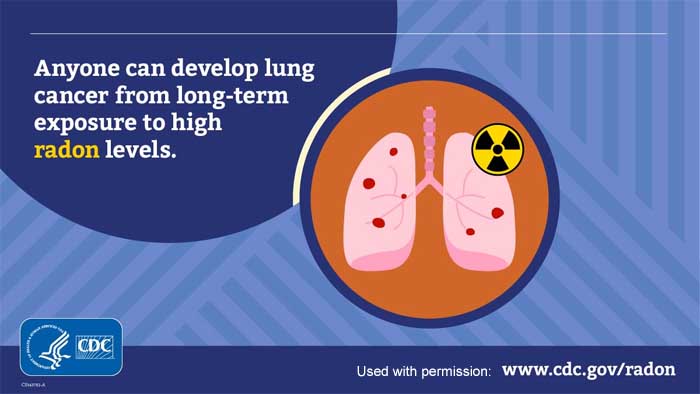
The results are undeniable and statistics from nationwide health data show your chance of cancer from Radon and/or smoking. Renny our Radon robot presents this serious topic with a caring and concerned spirit, as we tackle the serious topic of Radon in homes.
Convincing & Concerning Stats & Charts
The EPA guide includes a chart that summarizes research estimating chances of getting lung cancer from Radon. The chart makes a strong case for Radon mitigation and smoking cessation. The EPA points out that your chances if getting cancer depend on factors such as
- How much radon is in your home
- The amount of time you spend in your home
- Whether you are a smoker or have ever smoked
Radon Risk If You Smoke:
| Radon Level | If 1,000 people who smoked were exposed to this level over a lifetime | WHAT TO DO: Stop Smoking and |
| 20 pCi/L | About 260 people could get lung cancer | Fix your home |
| 10 pCi/L | About 150 people could get lung cancer | Fix your home |
| 8 pCi/L | About 120 people could get lung cancer | Fix your home |
| 4 pCi/L | About 62 people could get lung cancer | Fix your home |
| 2 pCi/L | About 32 people could get lung cancer | Consider fixing between 2 and 4 pCi/L |
| 1.3 pCi/L | About 20 people could get lung cancer | Reducing radon levels below 2 pCi/L is difficult |
Radon Risk If You Have Never Smoked:
| Radon Level | If 1,000 people who smoked were exposed to this level over a lifetime | WHAT TO DO: Stop Smoking and |
| 20 pCi/L | About 36 people could get lung cancer | Fix your home |
| 10 pCi/L | About 18 people could get lung cancer | Fix your home |
| 8 pCi/L | About 15 people could get lung cancer | Fix your home |
| 4 pCi/L | About 7 people could get lung cancer | Fix your home |
| 2 pCi/L | About 4 people could get lung cancer | Consider fixing between 2 and 4 pCi/L |
| 1.3 pCi/L | About 2 people could get lung cancer | Reducing radon levels below 2 pCi/L is difficult |
Comparison data calculated using the Centers for Disease Control and Prevention's 1999-2001 National Center for Injury Prevention and Control Reports.
So How much Radon is OK?
After looking at those dismaying stats and charts, one wonders how much Radon is OK? After all, smokers know that they have an elevated risk of lung cancer. And now, smokers find out that their risk is even higher if their home has high Radon levels. Plus, high Radon levels alone present a cancer risk, whether a person is into smoking or not.
The U.S. Congress has set a long-term goal that indoor Radon levels should be no more than outdoor levels. What is that? It's about 1.3 pCi/L. The EPA guide points out that roughly 0.4 pCi/L of Radon is normally found in the outside air; however, this level also varies by region and weather conditions, as well. Therefore, good for EPA in publishing a goal for us to reduce Radon levels in homes to 2 pCi/L or less, because as they say, "A Radon level below 4 pCi/L still poses a risk. Consider fixing when the Radon level is between 2 and 4 pCi/L."
About This Radon Guide
Home Buyer's and Seller's Guide to Radon is a publication by the Environmental Protection Agency. This page is part of our multi-page review of the EPA Guide to Radon. This series is provided to inform about Radon at Lake Tahoe and beyond. By getting Radon detection and Radon mitigation, you can live more healthfully amidst the beauty of Lake Tahoe.
On each page of this series, you can view more by clicking on one of the navigation links below.
Navigation: More Radon Information

|

|