
Explaining Sub-Slab Depressurization for Radon in Homes
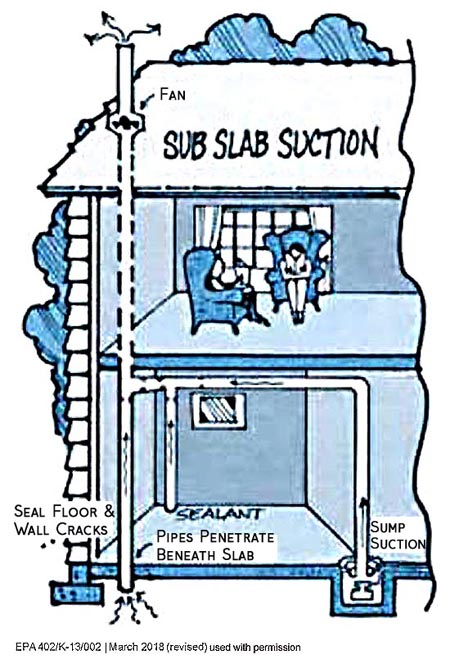
Renny the Robot thinks this diagram of a Radon reduction system is great, and so do we! Renny and other robot friends pop up throughout our Radon guide, offering a cheerful presence as we explore the serious issue of Radon in homes.
The EPA's Diagram of Sub-Slab Depressurization for Radon Reduction
The EPA's diagram of Radon reduction in a two-story home is a great because it communicates an easily understood picture of a Sub-Slab depressurization system, which is for the purpose of reducing Radon in a home.
Sub-Slab Suction from the ground up...
- Pipes penetrate beneath the slab
- Suction pulls air with Radon up sealed PVC pipes toward the Radon fan in the attic and the air is pushed up and out the top of the pipe
- Floor and wall cracks are sealed to prevent air seepage and ensure effective Sub-Slab suction
This is just one of the techniques for reducing Radon, as discussed in EPA's Guide to Radon for homeowners.
The EPA also emphasizes that homeowners should also test again after it is fixed, to be sure that Radon levels have been reduced. Other advice is that if your living patterns change and you begin occupying a lower level of your home (such as a basement), you should retest your home on that level.
In addition, it is a good idea to retest your home sometime in the future to be sure Radon levels remain low. The EPA Guide posits several scenarios that warrant re-testing, from major renovations, such as converting an unfinished basement area into living space, to changes in home use, such as putting a rec. room in the basement.
When reading the EPA Guide, one can imagine testing and re-testing over the years, due to possible changes in the path that Radon gas may take. This may seem like too much to do, but a word to the wise should be sufficient.
This series is provided to inform about Radon at Lake Tahoe and beyond. On each page, you can view more by clicking on one of the navigation links below.

Navigation: More Radon Information

|

|